Mr. Sunshine (2018) Review: Love, Resistance, and the End of an Era
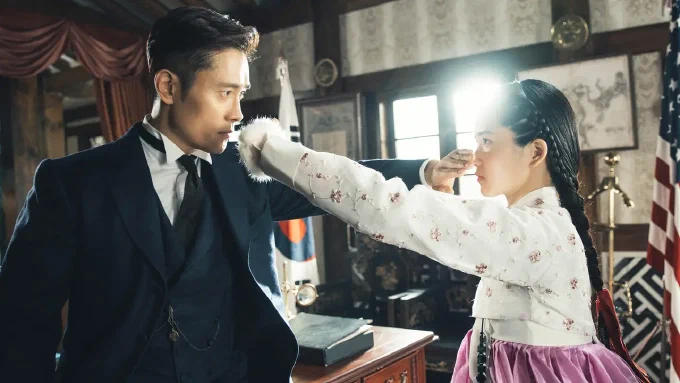
Set in Korea at the turn of the twentieth century, during the final years of the Joseon dynasty before Japan’s annexation of the peninsula, Mr. Sunshine tells the story of an unlikely romance between Eugene Choi, a Korean-born captain in the U.S. Marine Corps, and Go Ae-shin, an aristocrat who secretly fights as a sniper for the Korean resistance.
Rather than relying solely on its love story, the series weaves together political intrigue, richly developed characters, breathtaking cinematography, and meticulous production design into one of the most ambitious historical dramas television has produced.
An Epic That Takes Its Time
Across its 24 episodes, the central romance gradually becomes intertwined with the geopolitical struggle between Korea, Japan, and the United States during one of the country’s most turbulent periods.
The world feels remarkably authentic. Rather than treating history as a backdrop, the series immerses viewers in the cultural and ideological clashes between the three nations, showing how each understands honor, power, and loyalty through a different lens.
A few things are worth knowing before you start:
- Length: 24 episodes, each running about 65–70 minutes, with the finale approaching 80 minutes.
- Pacing: This isn’t the kind of drama you race through over a weekend. In terms of scope, it feels closer to three eight-episode seasons than a conventional Korean series.
- Viewing experience: Mr. Sunshine rewards patience. Watching an episode every few days allows its emotional weight and visual craftsmanship to settle in. Like many great epics, its true scale only becomes apparent over time.
Unlike most historical dramas, which focus on kings and military leaders, Mr. Sunshine shines a light on those who usually remain at the margins of history—women, former slaves, and ordinary civilians. It captures a society caught between two eras: slavery has only recently been abolished, Western influence is reshaping Korean society, and Japanese annexation is drawing ever closer.
History and Fiction
Many international viewers approach historical dramas as introductions to Korean history. While Mr. Sunshine draws heavily from real events, it also compresses timelines, invents characters, and reshapes history for dramatic effect.
For Korean audiences, the distinction between historical fact and fictional storytelling is generally clear. For viewers unfamiliar with the period, it’s much less obvious.
Here’s where the series stays close to history—and where it takes creative liberties.
The Characters Behind the Drama
Go Ae-shin (Kim Tae-ri)
Go Ae-shin herself is fictional, but much of her story draws inspiration from real history.
Her family’s tragedy echoes the political turmoil of the late nineteenth century, while her decision to join the Righteous Army (Uibyeong) reflects an actual civilian resistance movement that fought against growing Japanese influence.
The show’s biggest historical liberty is its timeline. The resistance movement portrayed in the series did not truly emerge until after the assassination of Empress Myeongseong in 1895. By moving these events earlier, the writers strengthen Ae-shin’s personal story but sacrifice historical accuracy.
Eugene Choi (Lee Byung-hun)
Born into slavery, Eugene escapes to America after his parents are killed and eventually returns to Korea as a captain in the U.S. Marine Corps.
Although fictional, the character is partly inspired by Hwang Ki-hwan, a real Korean immigrant who moved to the United States in the early twentieth century. He later served in the U.S. Army during World War I before becoming a representative of the Korean Provisional Government in Europe, helping Korean immigrants avoid deportation to Japanese-controlled Korea.
His forgotten grave was rediscovered in New York in 2008, decades after the South Korean government had posthumously honored him for his contributions to Korean independence.
Gu Dong-mae (Yoo Yeon-seok)
The son of a butcher—a member of one of Korea’s lowest social classes—Dong-mae flees to Japan, becomes a samurai, and eventually returns as the leader of a ruthless organization known as Musin.
Historically, Musin closely resembles the nationalist Japanese groups Genyōsha and Kokuryūkai (Black Dragon Society), organizations involved in espionage and expansionist politics during the period.
Dong-mae also became the center of one of the series’ biggest controversies. Some Korean viewers felt the original script implied that Japanese brutality could be partially explained by Korea’s own discrimination against people like him. Following public criticism and a petition submitted to the Blue House, the production removed direct references to real organizations and added a disclaimer clarifying that the story was fictional.
Kudo Hina (Kim Min-jung)
Another fictional character, Hina runs the luxurious Glory Hotel after being forced into marriage with an elderly Japanese businessman.
The hotel itself is modeled almost directly on Seoul’s historic Sontag Hotel, the country’s first European-style hotel. Opened in 1902 by German entrepreneur Antoinette Sontag, it became a gathering place for diplomats, politicians, and foreign visitors—and one of the first places in Korea where coffee was formally served.
Kim Hui-seong (Byun Yo-han)
Initially introduced as Ae-shin’s aristocratic fiancé, Hui-seong gradually evolves into one of the series’ most sympathetic characters.
Ashamed of his family’s role in Korea’s rigid class system, he abandons privilege and becomes a journalist documenting Japanese atrocities and the signing of the 1905 Eulsa Treaty, which effectively stripped Korea of its sovereignty.
Through him, the series highlights the often-overlooked role of early Korean journalists in preserving historical truth.
Jang Seung-gu and Lee Wan-ik
Both characters are fictional but represent broader historical realities.
Jang Seung-gu embodies the fate of Korean soldiers who resisted Japan during the forced disbandment of the Korean army in 1907.
Lee Wan-ik serves as a composite of the infamous Five Eulsa Traitors—the ministers who signed the 1905 treaty that placed Korea under Japanese protectorate rule.
Emperor Gojong
Unlike most of the principal cast, Emperor Gojong is a historical figure.
He ruled Korea through one of its most unstable periods, attempting to balance the competing interests of Russia, Japan, and the United States while navigating intense political divisions within his own government. In 1907, Japan forced him to abdicate, marking another decisive step toward full annexation.
A Finale Rooted in History
The series reaches its emotional peak not through its romance, but by honoring the anonymous men and women who fought for Korean independence.
In the final episode, Eugene leads a foreign journalist to a hidden camp of resistance fighters in the mountains. The scene recreates a real historical photograph taken in 1907 by British journalist Frederick McKenzie of the Daily Mail. The image—one of the few surviving photographs of the Righteous Army—is reproduced in virtually every Korean history textbook.
The dialogue closely echoes McKenzie’s own memoirs. One resistance fighter tells him:
“We know we will all die if we continue fighting. But we refuse to live as slaves to Japan. We’d rather die as free men.”
Whether every detail is historically accurate matters less than what the series ultimately achieves.
Mr. Sunshine transforms names, dates, and textbook events into living, breathing people. It reminds us that history is not only shaped by emperors, diplomats, and generals, but also by countless ordinary individuals whose names have largely been forgotten—people who chose resistance over submission, even when they knew the cost.