The Fallen Leaf (2019) Review: When an Actress Carries an Entire Drama
Spoiler warning: This review discusses major plot points, including the ending.
The Fallen Leaf is one of those dramas that is difficult to rate simply. It is messy, melodramatic, uncomfortable, occasionally absurd, and sometimes frustrating—but it is also emotionally intense, visually beautiful, and impossible to dismiss.
At its core, the series is a story about trauma, identity, family rejection, revenge, and, ultimately, learning to live with yourself. It deals with gender identity, transgender identity, domestic abuse, infidelity, mental illness, suicide, discrimination, and complicated family relationships. None of these subjects are particularly light, and The Fallen Leaf does not exactly approach them with subtlety. Yet beneath all the melodrama is a surprisingly thoughtful story about what happens when unresolved childhood trauma follows someone into adulthood.
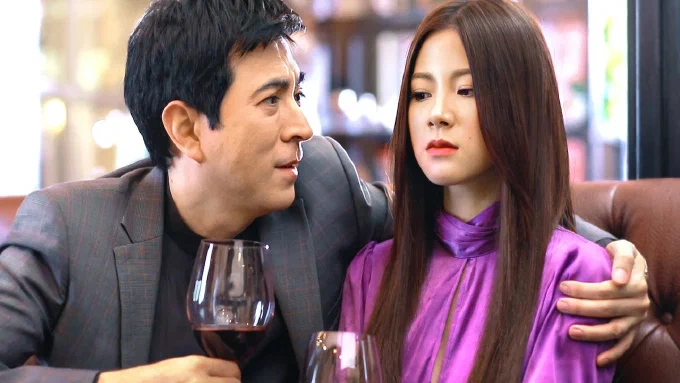
And the biggest reason the story works at all is Nira, played brilliantly by Baifern Pimchanok Luevisadpaibul.
Nira Is the Heart of the Series
Nira is an exceptionally complicated protagonist. She is intelligent, determined, beautiful, vulnerable, manipulative, loving, cruel, and deeply damaged. She can be frustrating to watch because many of her decisions are destructive, but that is also what makes her feel human.
She returns to Bangkok carrying years of pain and resentment toward the people who made her childhood unbearable. Her revenge initially seems straightforward: she wants to hurt the father and aunt who hurt her. But as the story progresses, it becomes clear that revenge is not actually going to fix what is broken inside her.
That is where Baifern’s performance becomes essential.
She does not simply play Nira as a glamorous woman executing a revenge plan. She gives the character an enormous amount of emotional depth. Her expressions, body language, silences, and especially her crying scenes communicate things that the script sometimes struggles to put into words. When Nira breaks down, it feels less like a dramatic performance and more like watching someone who has been holding herself together for far too long finally collapse.
The most interesting thing about Nira is that she is not portrayed as a perfect victim. She makes mistakes. She lies to people who genuinely care about her. She manipulates situations, allows her hatred to consume her, and sometimes hurts people who do not deserve it. Her mental state makes many of her choices even more complicated.
That does not excuse everything she does—but it makes her worth understanding.
The series gradually reveals that Nira’s biggest battle is not really against her father or aunt. It is against the unresolved pain she has carried since childhood.
Trauma Is More Important Than Revenge
One of the things I appreciated most about The Fallen Leaf is that the revenge plot eventually becomes secondary to Nira’s psychological journey.
At first, it is easy to see the series as a revenge story: a person who was abused and rejected returns years later as someone her family does not recognize and begins dismantling their lives.
But the more we learn about Nira, the more complicated that interpretation becomes.
She has happy memories of her childhood as well. Her relationship with her mother was loving, and her memories of Chut contain genuine affection and warmth. Those memories are important because they prevent her past from becoming a simple story of uninterrupted misery.
In fact, the happy memories sometimes make things worse.
They remind Nira of the person she once was and of the people she once loved. Her past is not simply something she wants to escape—it is something she desperately wants to recover. That creates a painful contradiction: she wants revenge for what happened to her, while simultaneously longing for the family and affection she never really had.
This is why the ending works better than a conventional revenge-story conclusion.
Nira cannot simply destroy everyone who hurt her and suddenly become healthy. She needs to confront herself.
The Complicated Relationship With Chut
The romance between Nira and Chut will probably be the most divisive element of the series.
They are not blood relatives, but Chut knew Nira as a child and was deeply attached to her before she transitioned. That history inevitably gives their relationship an uncomfortable pseudo-incestuous undertone, particularly because the drama deliberately emphasizes their childhood bond.
At the same time, the series makes it clear that Nira’s feelings for Chut are deeply connected to her past. He was one of the few people who treated her kindly when she was young, and that emotional attachment survives into adulthood.
The problem is that Nira is also entering a relationship with a married man while hiding a fundamental truth about her identity and her connection to him. That creates an unhealthy foundation from the beginning.
I actually think the decision not to give them a conventional happily-ever-after ending was the right one.
As beautiful as some of their scenes together are, there is simply too much unresolved trauma, deception, grief, and emotional baggage between them. A romantic reunion would have felt more like wish fulfillment than genuine character development.
Chut also has his own journey. He is haunted by the loss of Nira’s childhood identity and by the realization that the person he thought he had lost is still alive, but has become someone he never expected. His marriage has also left him emotionally damaged.
His relationship with Nira is therefore not simply a love story. It is also a story about grief, memory, identity, and whether love can survive when the people involved have changed beyond recognition.
The Supporting Characters Deserve More Credit
Although Nira dominates the drama, some of the supporting characters are surprisingly well developed.
Dr. Ben is probably the easiest character to root for. He accepts Nira without demanding that she become someone else. More importantly, he understands that loving someone does not mean possessing them. When he realizes that Nira cannot return his feelings in the same way, he is still willing to be there for her.
That makes him one of the healthiest relationships in the entire series.
Then there is Nira’s father, Chom.
For most of the drama, he is almost impossibly easy to hate. He is abusive, narcissistic, shallow, bigoted, and repeatedly contributes to the destruction of his own family. The series does not ask us to excuse him.
What surprised me, however, was how his character changes toward the end.
Learning Nira’s identity forces him to confront the consequences of his own behavior. He has to realize that the child he rejected and mistreated did not simply disappear. The person he thought was gone is still there—and the damage he inflicted helped shape the person Nira became.
His late realization does not erase his previous behavior, but it does give the character another dimension.
The same is true of Aunt Rong. She is extremely difficult to like for most of the series, and much of what happens to Nira can be traced back to her actions. Yet the final episodes give her a chance to show regret and vulnerability.
Neither character receives a magical redemption. They simply begin to understand what they have done.
That distinction matters.
The People Around Nira
Some of the smaller relationships are actually among the most emotionally satisfying parts of the drama.
Nira’s friendship with Yod and her relationship with Tong provide warmth in an otherwise very dark story. They are people who care about her even when they know she is hiding things from them.
Uncle Pon is another important figure because he represents unconditional acceptance. Unlike so many people in Nira’s life, he does not need her to justify who she is.
These relationships remind us that Nira is not completely alone. She has people who love her. The tragedy is that she is often too consumed by her trauma to recognize how much support she actually has.
The Drama Does Not Handle Everything Perfectly
This is where The Fallen Leaf loses some points for me.
The writing can be extremely uneven.
There are moments when the series feels like a genuinely thoughtful psychological drama, followed immediately by something that belongs in the most exaggerated soap opera imaginable. Some conflicts are clearly constructed for maximum shock rather than because they naturally follow from the characters.
The villains can also become cartoonishly cruel, and certain storylines receive more screen time than they deserve. A shorter episode count might have helped considerably. Several viewers have noted that the drama could probably have been tightened by a few episodes, particularly where the scheming and repeated confrontations begin to feel repetitive.
Some of the dialogue and sound effects also occasionally push the series into unintentional camp territory.
But strangely enough, this does not completely destroy the experience.
There is something addictive about the chaos.
Once you become invested in Nira, you want to know how everything is going to end—even when you are questioning the writing choices along the way.
A Drama About Gender Identity—But Also About Acceptance
The treatment of gender identity is one of the most important and controversial aspects of The Fallen Leaf.
The drama sometimes handles the subject beautifully, particularly through Nira’s personal experience of rejection and her desire to be accepted as herself. At other times, its approach can feel overly melodramatic or overly focused on gender roles.
That inconsistency is worth acknowledging.
This is not necessarily a perfect representation of transgender identity, and viewers should not approach it as a definitive guide to the transgender experience. It is, first and foremost, a dramatic story about one person’s identity and trauma.
What it does succeed in doing is forcing the audience to think about how family, society, and personal expectations shape the way people understand themselves.
And that is particularly powerful when we see how much of Nira’s suffering comes from other people’s inability to accept her.
The Ending
The final episodes are where everything finally comes together.
Nira’s emotional breakdown is difficult to watch, but it makes sense within the story that has been building around her. For years, she has tried to solve emotional wounds through revenge, relationships, appearance, and control.
None of those things work.
Eventually, she has to accept that she needs help.
I was actually relieved that the drama did not give Nira a conventional romantic happy ending. It would have been emotionally satisfying in the moment, but it would have undermined the entire point of her journey.
Nira needs time.
She needs to discover who she is outside of her childhood trauma, outside of her revenge, and outside of her relationship with Chut. Most importantly, she needs to learn how to love herself without needing someone else to validate her existence.
The ending is bittersweet, but it feels earned.
In a way, everyone receives some form of resolution. Chut is forced to confront his own life and choices. Dr. Ben continues moving forward. Nira finally begins the process of healing. Even Chom and Rong are forced to face what they have done.
Nobody gets everything they want.
And that is exactly why the ending works.
The Visuals and Music
One area where the drama consistently succeeds is presentation.
The cinematography is gorgeous. The lighting, framing, costumes, and overall visual style give the series a sense of melancholy and fatalism that feels surprisingly sophisticated.
There is often a strong contrast between Nira’s outward appearance and what is happening emotionally underneath. She can look completely composed in one scene and psychologically shattered in the next.
The music also deserves a mention. It fits the emotional atmosphere well, often giving the more painful scenes an almost nostalgic quality.
The production is not flawless, but visually it frequently feels much more expensive and polished than one might expect.
Final Thoughts
The Fallen Leaf is not a perfect drama.
Its script can be ridiculous. Some characters are frustrating. Certain plot twists feel forced. The romance is complicated enough to make many viewers uncomfortable, and the treatment of some serious subjects can be inconsistent.
But I also think that focusing only on those weaknesses misses what makes this drama memorable.
At its best, The Fallen Leaf is a story about a deeply wounded person trying to turn pain into revenge, only to discover that revenge cannot give her the thing she actually needs.
And Baifern Pimchanok is the reason that journey works.
Her performance gives Nira a vulnerability and emotional intensity that the script does not always deserve. She makes the character’s anger believable, her grief painful, and her moments of weakness devastating. Even when the story becomes excessive, she keeps Nira grounded.
That is ultimately what stayed with me.
Not the revenge schemes. Not the melodrama. Not even the romance.
It is Nira herself.
The Fallen Leaf is best approached with an open mind and realistic expectations. Do not watch it expecting a cute romance or a straightforward revenge story. Go in expecting a messy, dark, emotionally charged drama about identity, trauma, family, and the complicated process of learning to accept yourself.
It may frustrate you.
It may make you uncomfortable.
It may occasionally make you wonder what the writers were thinking.
But if you stick with it, the final episodes give the entire story a surprising emotional weight.
Not a perfect drama—but a memorable one. And sometimes that matters more.